What is your all time favorite automobile?
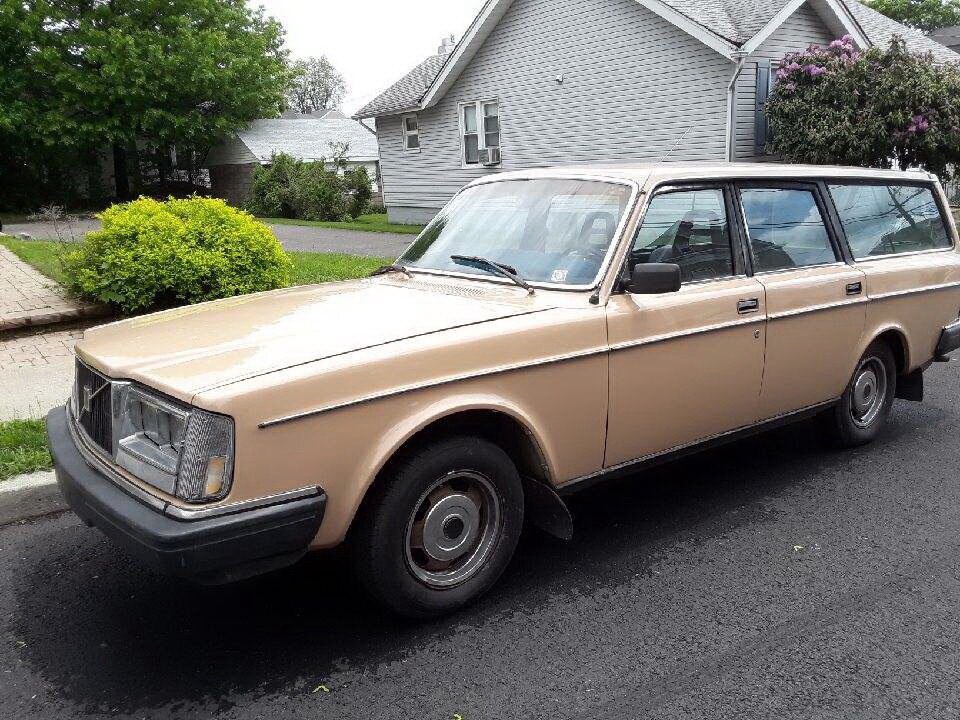
In the picturesque city of Tacoma, Washington, where the misty mountains kissed the sky, there was a Volvo 240 DL that embarked on a legendary journey, leaving tire tracks etched in the stories and hearts of its owners. She was tan, with 280,000 miles on the second engine and covered in Grateful Dead stickers by the time I was old enough to buy it off my older brother for $2000.
Born in the autumn of 1974, the Volvo 240 DL graced the enchanted roads with its presence. Its front end bore a “shovel nose,” a magical resemblance to the VESC prototype vehicle, setting it apart from its predecessors, the 140 and 160 Series. Yet, beyond the shovel nose, the 200 Series shared a kinship with its predecessors, almost identical from the bulkhead to the very rear end.
In the year 1978, a mystical facelift bestowed upon the sedans a redesigned rear end with wraparound taillights and a trunk opening adorned with a lower lip. The dashboard, inspired by the safety fascia of the 100 Series, showcased slatted “egg crate” style air vents, a departure from the earlier eyeball style vents.
As the tale unfolded, the Volvo 240 DL offered a magical choice of transmissions – a four-speed manual or a three-speed automatic, with overdrive as a graceful option for the 244GL and a five-speed manual for the 264GL and 265GL.
The autumn of 1975 brought forth a revelation in the form of the 265 DL estate, the first production Volvo estate powered by a six-cylinder engine. It became a symbol of strength and grace on the roads of Tacoma, with improved gearbox choices and a heartier B21A engine.
At the 1976 Paris Motor Show, the 264 TE, a seven-seat limousine, made its debut, stretching the limits of automotive elegance on its 3,430 mm wheelbase. Royals and political leaders alike embraced its luxurious charm.
The years unfolded with engine upgrades, design tweaks, and even a sportier 242 GT in 1977. In 1978, the grille received a chrome surround, mirrors turned black, and interval wipers made their debut, ushering in a new era of Volvo charm.
In 1979, a grand facelift enveloped the Volvo 240 DL, introducing square headlamps on the DL and rectangular headlamps on the GL and GLE. The sedans flaunted wraparound rear lamp clusters, and the GLE made its debut. The following year welcomed the sporty GLT, replacing the GT, and 1981 brought a new grille and redesigned taillights for the station wagons.
The narrative continued with incremental improvements, the arrival of the Turbo, and a more powerful 2.8-liter engine for the six-cylinder models in 1981. The dashboard underwent a significant transformation, embracing a larger binnacle and redesigned instrument pods.
In a momentous stride for environmental harmony, the introduction of the oxygen sensor in 1976 marked a turning point, fine-tuning the air and fuel mixture for superior emissions, drivability, and fuel economy.
The chronicles of the Volvo 240 DL extended to the 1993 model, where one such noble steed was driven by none other than IKEA founder Ingvar Kamprad. The car, though beloved, yielded to the winds of change due to outdated safety design.
As the last chapter unfolded, the final 200 produced, a blue station wagon named the “Polar Italia,” became a relic displayed at the Volvo World Museum, symbolizing the end of an era. And so, the Volvo 240 DL left an indelible mark on the roads of Tacoma, Washington, a tale of safety, innovation, and enduring automotive magic. Her eventual demise came on a crisp fall day when she was totaled due to age- after she ate the ass end off a Prius with zero effort and a well deserved front end wrinkle.
Thank you for all of the wonderful years of service, dear Volvo. Unfortunately- I’ll forever be too broke to afford the wonder that is the XC 60. 😭😭😭

 🚢💋SEDONA SUNSETS💋🏴☠️
4 responses to “⚡️🏁THE VOLVO 240 DL🏁⚡️”
Keeping up with the Jones…!
LikeLiked by 1 person
I remember when those were the business! We always had Japanese cars though…sad!
I really enjoyed your post, mind if I link to it? Feel free to link to mine as well.
My site address: https://bunchiesblog777.com
LikeLiked by 1 person
Absolutely! 💯 Thank you for your support. 💋
LikeLiked by 1 person
What a lovely journey!
LikeLiked by 1 person